
The Construction AI Agent Implementation Playbook
Key findings
- 01
The market is still early enough to lead.
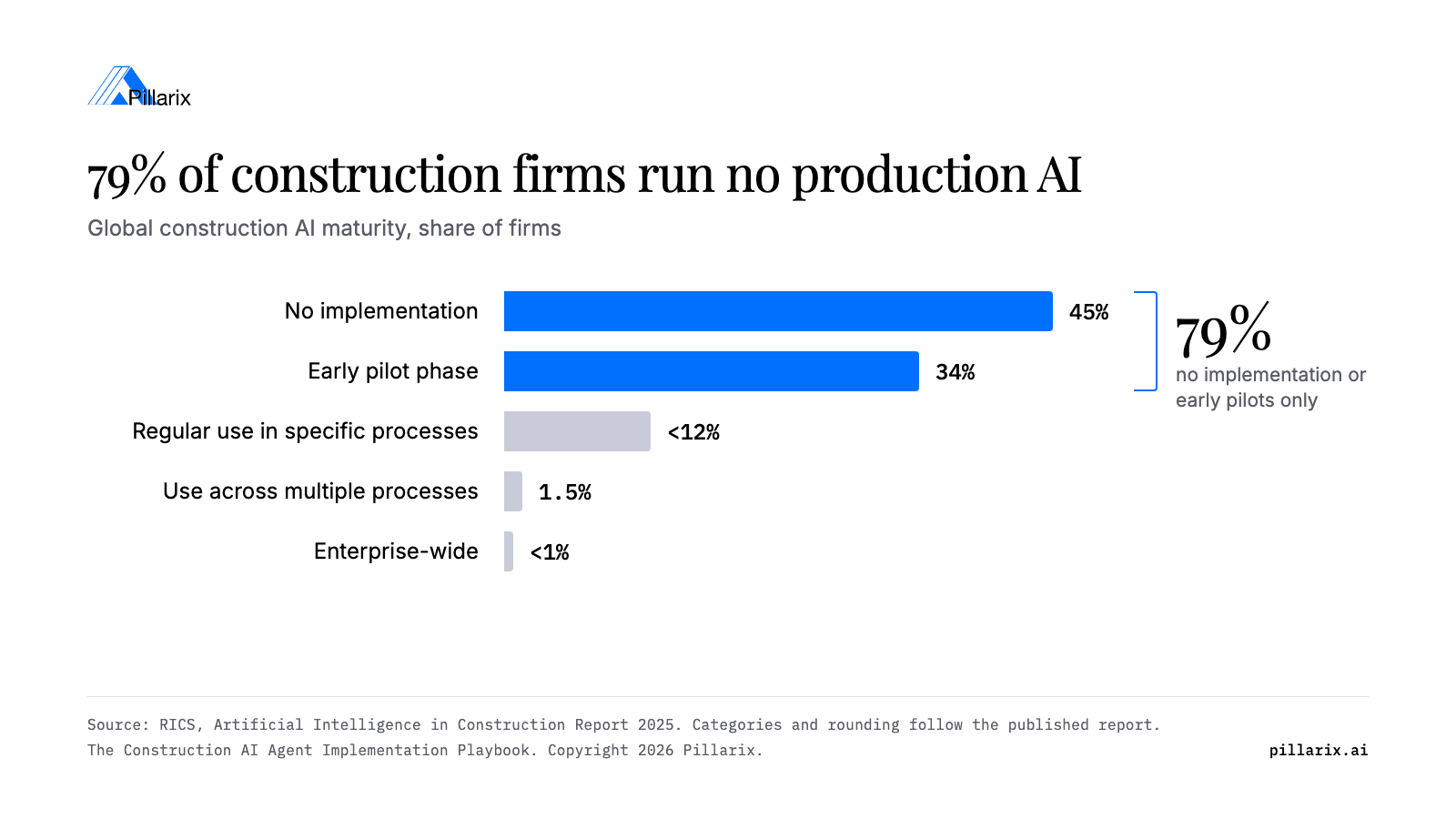
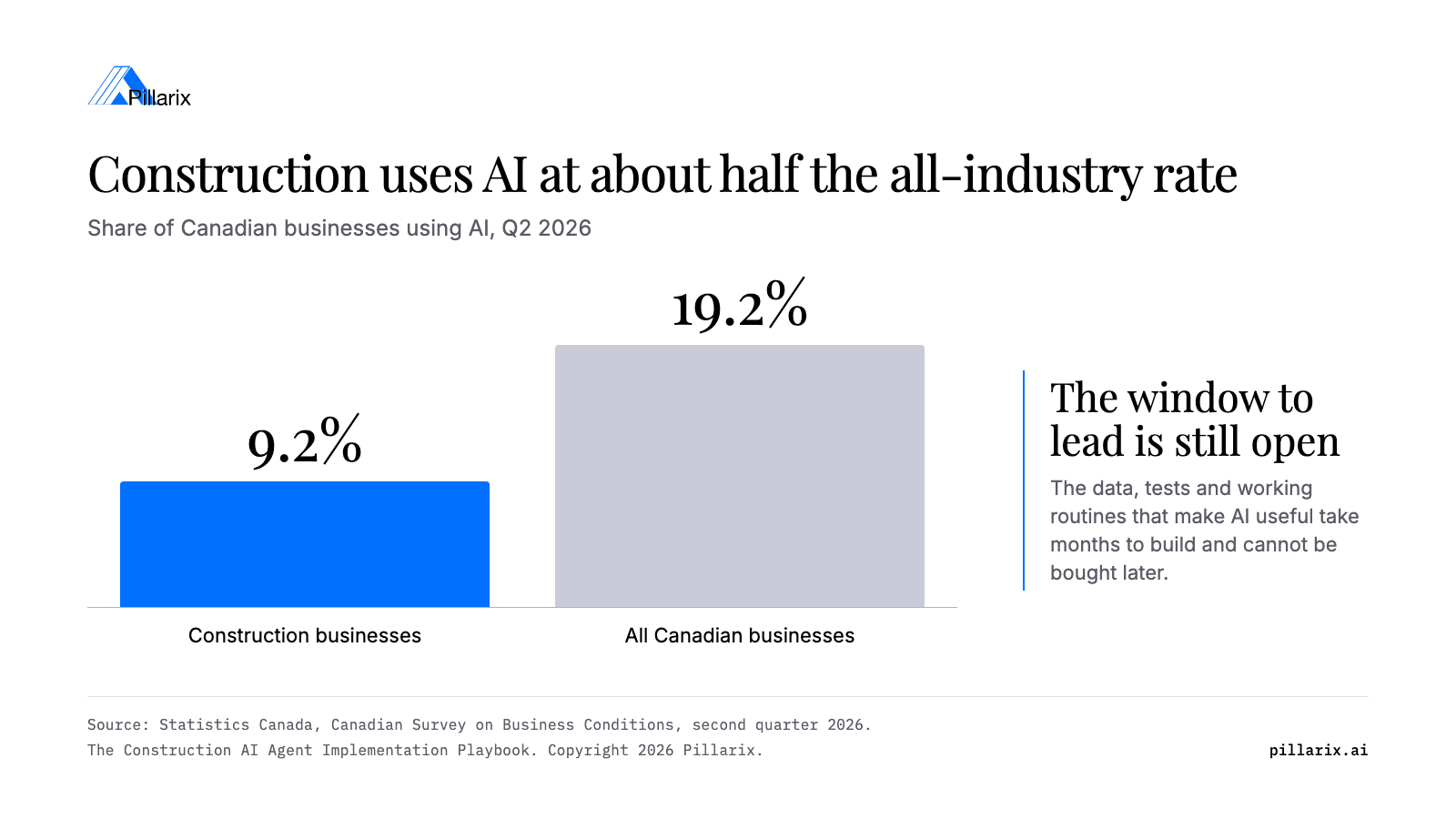
79% of construction firms run no production AI, and in Canada the industry uses AI at about half the all-industry rate. The data, tests and routines that make AI useful take months to build, so starting small now beats waiting.
- 02
Agents run the workflow and people keep the decisions.
Unlike a chatbot, an agent pulls the right project evidence, uses approved tools and tracks where the work stands. Anything touching safety, professional judgment, a contract commitment or real money still gets a human sign-off.
- 03
Start with repeated, document-heavy work.
Document search, monthly reporting, change chronology and RFI or submittal triage happen often and are easy to check, undo and measure. Payment approval and schedule write-back can wait.
- 04
Earn the right to scale, gate by gate.
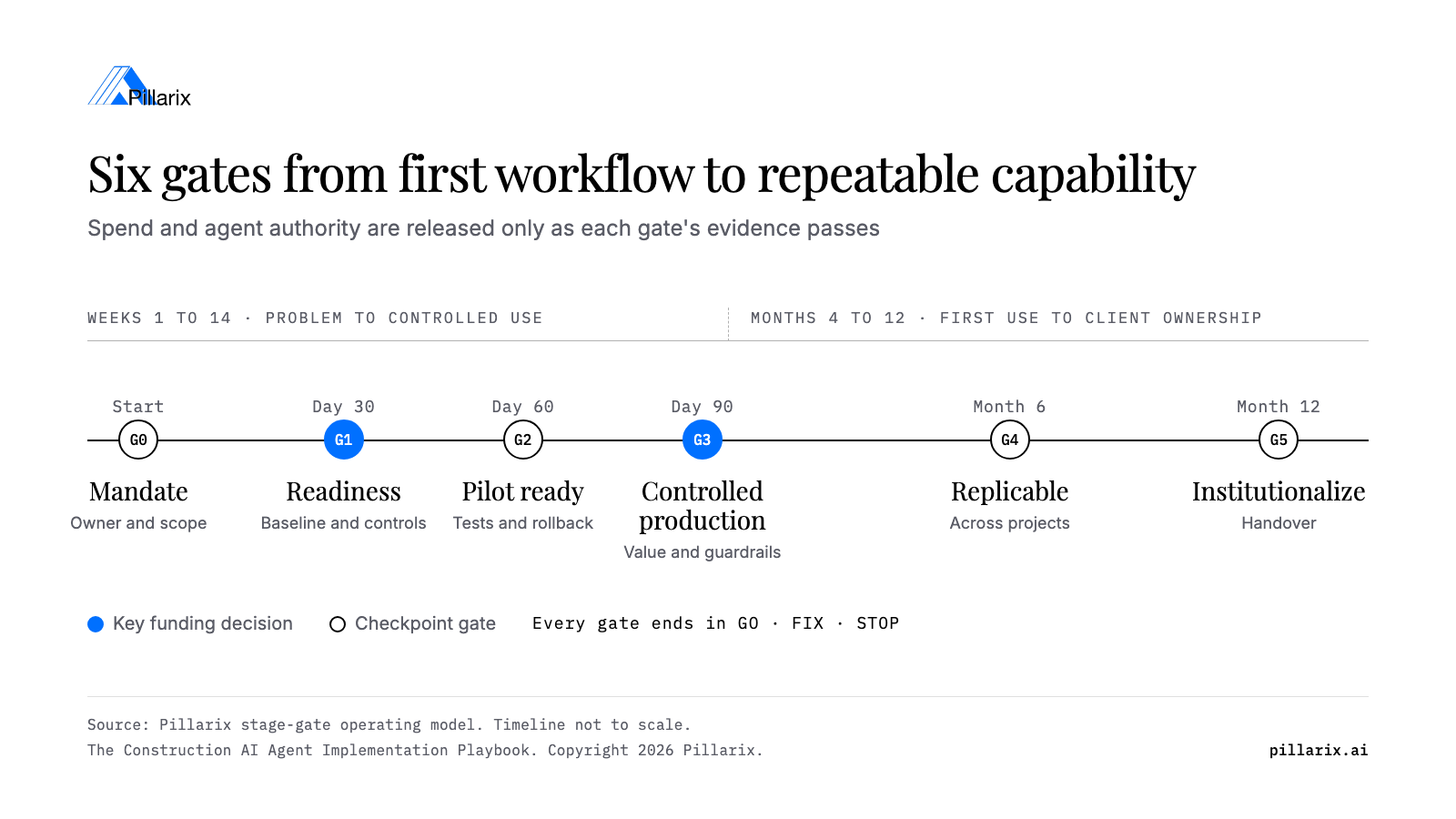
Six gates over twelve months, each ending in go, fix or stop. Funding and agent authority grow only as the evidence clears, never on the strength of a status slide.
A look inside
What’s in the full playbook
- 01Current State
Why is the window open, and what happens if we wait?
- 02Agentic AI 101
Which workflow can pay off without risks we can't control?
- 03Prove and Scale
How do we run each gate and prove the value?
- 04Delivery Partner
Which team should deliver it, and how do we keep accountability?
Along the way you’ll get the working tools behind each chapter:
- A weighted workflow scorer, plus the hard stops that rule a candidate out
- A readiness diagnostic across value, workflow, data, integration, evaluation, security and legal
- The Day 1 must-haves checklist, with an owner for every row
- Week-by-week plans for Days 1 to 30, Days 31 to 90 and Months 4 to 12
- Five levels of agent autonomy, from read-only to bounded execution
- A reference architecture for governed construction agents
- A value model your finance team can actually sign off on
- The partner test, listing the evidence to ask any delivery partner for
Four decisions by the last page
By the end, your leadership team should be ready to make four calls:
- 1Name the first workflow and the person accountable for it. No owner, no pilot.
- 2Set value, quality, adoption, risk and operations thresholds before building.
- 3Approve the 30-day sprint and the six evidence gates. Release funding as the evidence clears.
- 4Pick a construction-AI delivery partner. Keep the accountability on your side.